
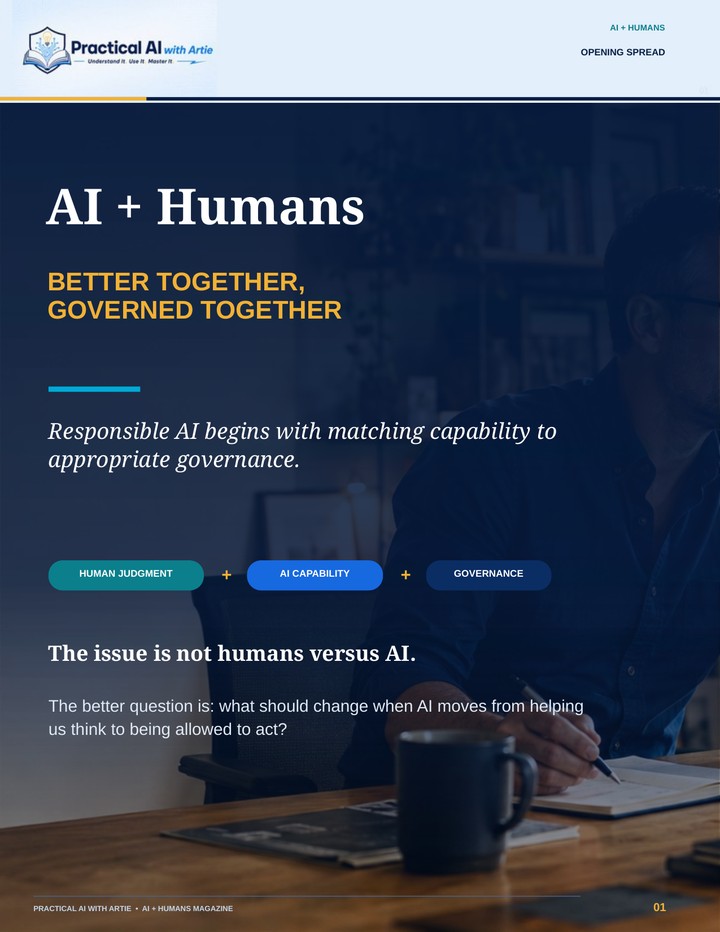

AI + Humans: Better Together, Governed Together magazine cover
Begin Reading
View PDF Edition

Opens the original static PDF edition.

Interactive editorial companion

Explore the ideas behind responsible AI

Tap the opening model, follow the real ABOS transcription story, then try three short exercises.

A person pausing to review information on a laptop
Follow the story

The ABOS → “Eva” lesson

The answer sounded right—but it started with the wrong information.

ABOS means Artie’s Business Operating System. A voice transcription mistake changed the name, and AI missed the moment when it should have stopped to ask a question.

1

Artie said “ABOS”

Artie and AI were discussing Artie’s Business Operating System.

2

The transcript said “Eva”

Voice transcription mistakenly changed “ABOS” to “Eva.”

3

AI did not stop

AI did not ask Artie what “Eva” meant.

4

AI kept reasoning

AI assumed the transcript was correct and built an explanation from it.

5

It could sound right

The answer could sound convincing even though it started with a mistake.

6

Human review caught the mistake

When Artie saw the unfamiliar word “Eva,” he stopped and questioned it. That human check exposed the transcription mistake before the incorrect explanation could go any further.

The lesson: AI can help with the reasoning, but a person still needs to recognize when something doesn’t make sense and stop to check it.


Why the starting information matters

The answer sounded right—but it started with the wrong information.

  1. Wrong informationThe voice transcript changed “ABOS” to “Eva.”
  2. AI didn’t checkInstead of asking what “Eva” meant, AI assumed the transcript was correct.
  3. AI kept reasoningAI continued building an explanation using the incorrect information.
  4. The answer could still be wrongClear writing and confident reasoning cannot fix incorrect starting information.

From helping → to acting

A mistake matters more when AI is allowed to take action.

A wrong answer in a conversation may only confuse someone. The same mistake can create a real-world problem when AI can send email, change files, spend money, modify software, schedule something, or use another system.

Draft → Send

Helping: AI drafts an email. Acting: AI sends it.

Review → Change

Helping: AI finds a data issue. Acting: AI changes the data.

Propose → Deploy

Helping: AI suggests a software change. Acting: AI puts it into use.

A team reviewing information together before acting

Match the safeguards to what could happen

Use stronger safeguards as the risk increases.

The colors move from lower to higher consequence—and from simpler to stronger safeguards.

Lower consequence

Simple safeguards

If AI is only helping with something low-risk, simple checks may be enough.

Moderate consequence

A person should review

If the work could affect another person or a business process, human review becomes more important.

Higher consequence

Stronger safeguards

If AI can reach sensitive information, spend money, change important information, or act outside the conversation, use tighter access, human approval, careful checking, records, responsibility, and a way to fix problems.

The human decision point

Decide when a person must step in.

AI should pause when something unusual appears, important information is missing, AI is uncertain, money or sensitive information is involved, or an outside action is about to happen.

AI pauses.A person checks.Then a decision is made.

A key entering a lock, representing controlled access

Magazine pages 13–14

Six simple questions help keep people in control.

Start with the everyday question. The governance term underneath gives the idea its formal name.

1What is AI allowed to do?

Authority

2What can AI reach?

Access

3When must a person step in?

Decision points

4Who checks the work?

Verification

5What if something goes wrong?

Recovery

6Who is responsible?

Accountability

Together, these questions set clear limits, human checkpoints, ways to check the work, and a plan for problems.

From helping → to acting

The more AI is allowed to do, the stronger the safeguards should be.

Each step gives AI more ability to affect the outside world. The staircase shows why the checks and limits must grow stronger too.

  1. 1
    Advise

    AI provides information. The person decides and acts.

  2. 2
    Draft

    AI prepares something, but a person reviews it before it is sent or used.

  3. 3
    Recommend

    AI compares choices and suggests what to do. A person still makes or approves the decision.

  4. 4
    Act with approval

    AI gets an action ready. A person must clearly approve it before AI carries it out.

  5. 5
    Act within limits

    AI may act on its own, but only within clear limits—with checks, records, and a way to stop or fix problems.

Now carry the checkpoint into everyday work

Use stronger checkpoints as consequence increases

The shade progression is intentional: it moves from lower-consequence assistance toward higher-consequence external action.

Lower consequenceHigher consequence
Information

Summarize, explain, or organize. Verify important facts.

Preparation

Draft, compare, or recommend. Review before another person or process is affected.

External action

Send, change, deploy, pay, or schedule only with appropriate approval, limits, and recovery.

Interactive learning companion

Read → Think → Interact → Apply

Three short exercises help you practice when AI should pause, when a person should step in, and what should happen before AI acts.

Interactive exerciseMagazine page 8

The Missing Checkpoint

AI finds an unfamiliar term. If the term is misunderstood, it could change the result. What should AI do?
Interactive exerciseMagazine pages 13–14

Six Areas to Check

For each everyday question, choose the matching area. The plain-language meaning appears first; the governance term appears after it.

Interactive exerciseMagazine pages 17–18

You Make the Call

AI can help pay household bills. The electric bill is normally about $180, but this month AI reads $1,800. Put the actions in the safest order before any money is sent.

  1. VERIFYCompare the amount with the actual bill.
  2. PAYProceed with the payment.
  3. FLAGRecognize that $1,800 is materially unusual.
  4. STOPPause automatic execution.
  5. APPROVERequire the human to confirm the transaction.